



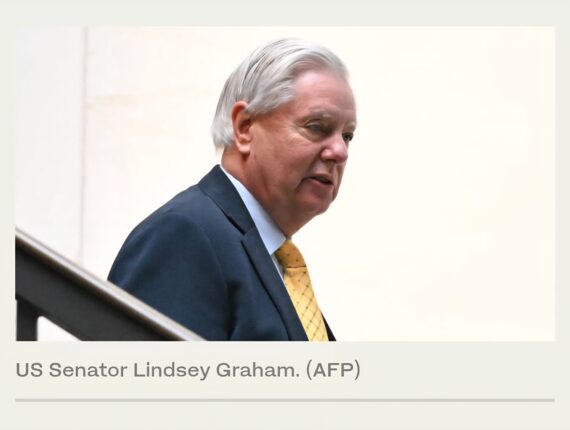
Saudi Arabia stands at a crossroads that few outside its own borders fully understand. Sen. Lindsey Graham, one of the most consistent American voices for Saudi-Israeli normalization, died on the night of July 11 with an ambitious autumn diplomatic push unfinished. He had briefed Saudi Ambassador to the US Princess Reema bint Bandar. He had briefed Foreign Minister Prince Faisal bin Farhan. He had told friends that he still had work to do on Israeli-Saudi normalization.
That work now belongs to those he leaves behind and it belongs, in a particular way, to a set of leaders that the American political class rarely turns to first. It belongs to the religious leaders of the Muslim and Jewish worlds.
The Abraham Accords have entered a season in which their expansion depends less on senators than on rabbis and imams, and less on treaty text than on relationships built over decades. Graham understood the Senate calendar. He understood the ratification threshold. What he could not build alone was the foundation of trust between two peoples that no treaty can substitute for. That foundation is what religious leaders build. It is what religious leaders have always built. And it is what the next chapter of the accords will require in a way the last chapter did not.
Saudi Arabia has been consistent for years about what it requires. Normalization with Israel must include a credible political horizon for Palestinians to live side by side with Israelis. That is not a maximalist demand. It is the considered position of a Kingdom whose monarch bears the title Custodian of the Two Holy Mosques and whose stewardship of Islam’s holiest sites carries a responsibility to the entire Muslim world. Negotiations around any peace agreement will secure movement on a pathway to Palestinian statehood. If anything, it is these reasons that now make the interfaith track so important.
The Israeli government has heard it. The American Senate has heard it. What has changed is that the man most positioned to translate that position into ratifiable American law is gone. What has not changed is the underlying religious truth the position rests on: that two peoples of faith can share a future when their faith leaders teach them how.
The children of Abraham were never meant to agree on everything. They were always meant to recognize one another.
Rabbi Marc Schneier
Here is what the accords actually are and what religious leaders must now teach the public they too often let politicians speak for.
The accords are the first admission by Arab countries and Muslim-majority states — five of them so far — that Jewish self-determination in the ancestral Jewish homeland is compatible with the Muslim faith. That admission took decades of relationships to build. It was built not by treaties but by teachers. Not by ministers but by imams, rabbis and scholars who understood that the deepest work of peace happens before the diplomats arrive and continues long after they leave.
The accords’ expansion to Saudi Arabia and one day to Indonesia, the world’s largest Muslim-majority nation, would produce more than a treaty. It would produce the political conditions to allow two peoples to live alongside one another each with their dignity intact. But only if religious leaders do the work that only they can do.
I have said this everywhere: in Riyadh, in Doha, in Manama, in Abu Dhabi, in Baku, in Astana and in Rabat. The children of Abraham were never meant to agree on everything. They were always meant to recognize one another. That recognition does not begin in the Senate. It begins in the mosque and in the synagogue. It begins between an imam and a rabbi who are willing to stand in one another’s houses of worship and say, publicly, that the other is not the enemy their politicians have taught them to fear.
I do not underestimate the moment. The Kingdom has been targeted by missiles. The region has entered a war it did not seek. Public opinion in the Muslim world has shifted and Muslim leaders have adjusted with it. None of this makes the work of religious reconciliation less urgent. It makes it more urgent. When the political architecture is uncertain, the religious foundation matters more, not less. When a senator like Graham is no longer at his desk, the rabbis and imams who understood what he was trying to build must now step forward and continue the work he began.
The rabbis and imams who understood what he was trying to build must now step forward and continue the work he began.
Rabbi Marc Schneier
What is at stake is larger than any one senator, any one election, any one government. The reconciliation of the spiritual center of Islam with the spiritual center of Judaism will reverberate to every place a Jew and a Muslim live as neighbors and to every place they do not yet know they can. It will weaken the antisemitism that disfigures Western capitals and the Islamophobia that rises beside it. It will carry a message the region has not heard in a generation: that the religions of Abraham, having tested one another for some 1,400 years, have arrived at the recognition that they were brothers all along.
Graham understood that a treaty was only the beginning. He was preparing to spend his fall making Saudi normalization real. We are the ones who must now step into the space he leaves.
There is no substitute for the presence of Muslims and Jews in one another’s lives. That is where peace begins. The most effective strategy for a shared tomorrow is normalization between Saudi Arabia and Israel, an American-led initiative that can reverberate across the globe.
Copyright © 2026 Foundation For Ethnic Understanding. All rights reserved. | Privacy Policy