


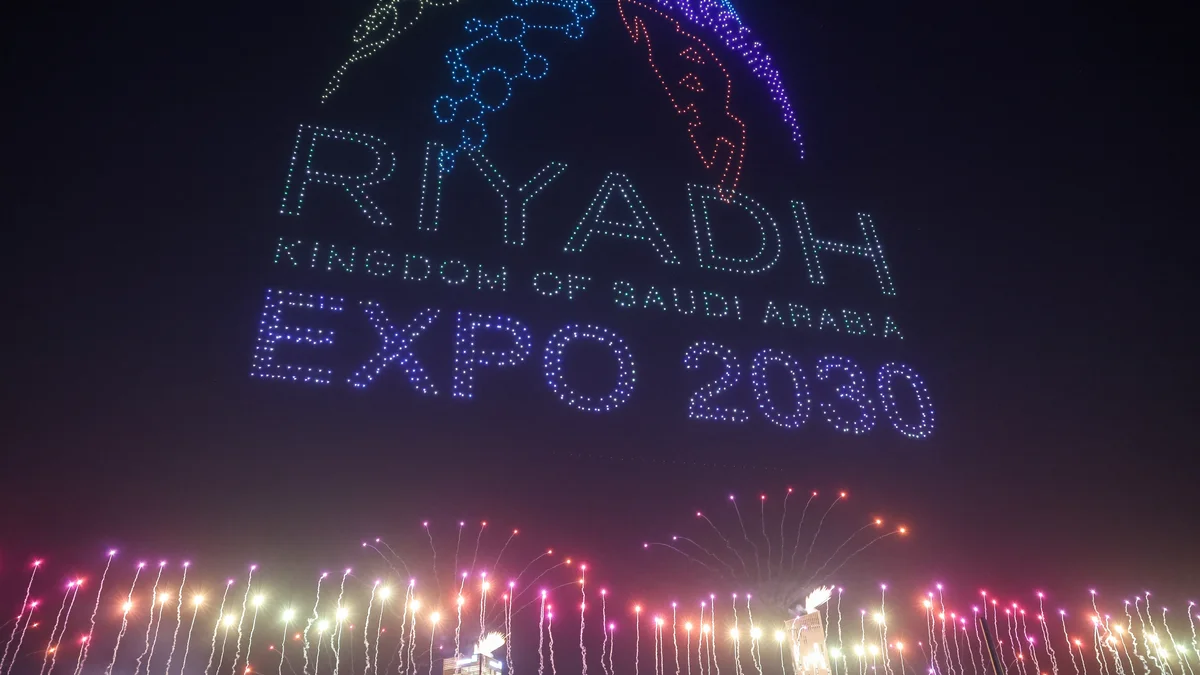
 Saudi Arabia is embracing the future while remaining firmly grounded in its Islamic faith, Arab heritage and national character (AFP)
At sundown on Sept. 11, Jewish families around the world will gather to welcome Rosh Hashanah by dipping apples in honey and praying for a sweet new year. Yet sweetness is only part of the meaning of this sacred season.
Rosh Hashanah is more than the Jewish new year. It marks the anniversary of the creation of the world and begins the Ten Days of Repentance, which culminate with Yom Kippur. During the holiday, we sound the shofar, a ram’s horn whose piercing call urges us to examine our actions and return to God. Maimonides taught that the shofar calls upon those who are spiritually asleep to awaken, search their ways and remember their Creator.
As I prepare to welcome the Jewish year 5787, I am also thinking about the new beginning taking shape in Saudi Arabia.
The Kingdom has entered the third and final phase of Vision 2030. What Crown Prince Mohammed bin Salman set in motion a decade ago has become a national transformation encompassing the economy, culture, infrastructure and daily life. The crown prince has emphasized that the most important investment made under Vision 2030 has been, and will continue to be, the investment in Saudi citizens.
Saudi Arabia is embracing the future while remaining grounded in its Islamic faith, Arab heritage and national character
Rabbi Marc Schneier
This is where Rosh Hashanah and Vision 2030 converge. The Jewish new year teaches that renewal does not require us to abandon who we are. It calls upon us to draw from the deepest sources of our identity as we build what comes next. Vision 2030 reflects that same principle on a national scale: Saudi Arabia is embracing the future while remaining firmly grounded in its Islamic faith, Arab heritage and national character.
The most important measure of this transformation may not be a statistic or a new skyline. It may be the confidence with which the Kingdom is opening itself to the world while remaining true to itself.
The economic results are substantial. By the end of 2025, non-oil activities accounted for 55 percent of real gross domestic product, while 93 percent of Vision 2030’s performance indicators had met their annual targets or were close to doing so. Yet, as a rabbi who has devoted his life to Muslim-Jewish relations, I am equally encouraged by the Kingdom’s growing commitment to cultural exchange, interreligious dialogue and peaceful coexistence.
Openness need not come at the expense of identity and tradition need not stand in the way of progress
Rabbi Marc Schneier
Global Harmony 2, an initiative of the Vision 2030 Quality of Life Program, last year celebrated 14 cultures represented among the Kingdom’s residents. It presented cultural diversity as a source of social harmony and human connection. Meanwhile, the King Abdulaziz Center for Cultural Communication’s partnership with the UN Alliance of Civilizations provides for joint efforts to combat hate speech, safeguard religious sites and promote shared human values.
These initiatives express an important truth: coexistence cannot depend solely upon occasional meetings or ceremonial declarations. It must be cultivated through institutions, strengthened through education and carried into the lives of ordinary people.
I have said this everywhere — in Riyadh, Doha, Manama and Baku — interreligious dialogue succeeds only when no one is asked to leave their faith at the door. Its purpose is not to make a Muslim less Muslim or a Jew less Jewish. Its purpose is to call Muslims and Jews to the highest teachings of their respective faiths: honoring human dignity, loving the stranger and pursuing peace.
After more than 20 years of building relationships across the Muslim world, I am convinced that strong religious identity and genuine openness are not opposing forces. The stronger we are in our faith, the more confidently we can encounter the faith of another.
Saudi Foreign Minister Prince Faisal bin Farhan recently described dialogue among followers of different religions as a “strategic necessity” and a fundamental pillar of a just and lasting peace. His words are especially timely as alliances across the region are being reshaped. Interreligious dialogue is not an ornament placed beside diplomacy. It is part of diplomacy because agreements among governments endure when they are supported by understanding among peoples.
As Rosh Hashanah approaches, I congratulate the crown prince on the extraordinary progress of Vision 2030 and the spirit of possibility it has inspired. The Kingdom is demonstrating that openness need not come at the expense of identity and that tradition need not stand in the way of progress.
On Rosh Hashanah, we do not pray merely to receive another year. We pray that we may become worthy of it. My prayer for 5787 is that it brings sweetness to the Jewish people, continued blessing to the Saudi people and deeper understanding among all the children of Abraham.
The future belongs to those who renew without forgetting who they are.
Copyright © 2026 Foundation For Ethnic Understanding. All rights reserved. | Privacy Policy