

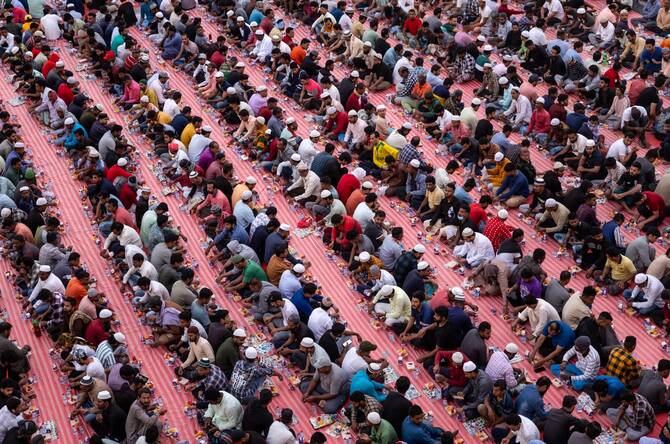
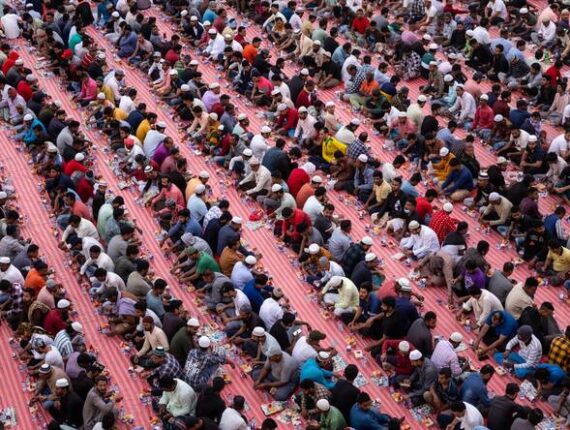
Iran’s aggression, which is intended to intimidate nations in the region, is producing the opposite effect (AFP)
Purim, the holiday commemorating the salvation of the Jewish people from Persian oppression more than 2,000 years ago, concluded last Tuesday evening, just as I arrived at an interfaith iftar hosted by the Bahrain Embassy in Washington. The story of Jews confronting persecution in ancient Persia carries striking resonance to the modern Iranian regime fueling instability across the Middle East.
Ramadan is observed as a month of fasting, prayer and introspection. Every evening during Ramadan, families and communities gather for iftar, the meal that breaks the daily fast at sunset.
Last Tuesday, the iftar, which was hosted by Bahraini Ambassador to the US Sheikh Abdullah bin Rashid Al-Khalifa, was attended by 300 guests from all walks of life. Sitting at the head table were ambassadors from across the Muslim world, including Sheikha Al-Zain Al-Sabah of Kuwait, Sheikh Meshal bin Hamad Al-Thani of Qatar, Princess Reema bint Bandar of Saudi Arabia, Talal bin Sulaiman Al-Rahbi of Oman, Youssef Amrani of Morocco, Sedat Onal of Turkiye and Khazar Ibrahim of Azerbaijan, along with myself, a rabbi.
“The symbolism of the iftar was salient. It felt as though history and the present converged in a single evening.”
Rabbi Marc Schneier
The symbolism was salient. I had just completed my observance of a holiday marking the defeat of an ancient Persian regime while sitting at a Ramadan iftar table with prominent leaders from across the Muslim world. It felt as though history and the present converged in a single evening.
Sheikh Abdullah eloquently reflected on the significance of the moment, noting that “Bahrain has never been a nation that seeks confrontation. We are guided by the principles of dialogue over division, partnership over polarization and coexistence over conflict. Under the wise leadership of His Majesty King Hamad bin Isa Al-Khalifa, Bahrain has consistently advanced these principles on the global stage. As a founding member of the Abraham Accords and a signatory to the Board of Peace, Bahrain joined its neighbors in continuing to champion a new chapter for the Middle East.”
He added: “Peaceful coexistence is not an aspiration for us; it is embedded in our national fabric. It is reflected in our 200-year-old Hindu temple, our nearly century-old synagogue, Christian churches dating back to the early 1900s and the largest cathedral in the Middle East.”
Iran continues to launch ballistic missiles and drones across the region, striking targets in countries including Bahrain, Qatar, Saudi Arabia, the UAE, Oman, Kuwait, Azerbaijan and Turkiye, all represented by their ambassadors at the iftar table.
This aggression, which is intended to intimidate nations in the region, is producing the opposite effect, as we sat together in a spirit of cooperation and shared concern for the future of the Middle East.
I repeatedly tell audiences around the world that the children of Abraham are bound by a common faith. As we now confront the shared threat of Iranian aggression, it is undeniably clear that we are also bound by a common fate.
Iran’s campaign of terror makes no distinction between Sunni or Shiite, Arab or Israeli, Muslim or Jew. Its missiles endanger cities, global energy infrastructure and civilian lives without discrimination.
The response emerging across the region suggests something equally important. The bonds that have been built between Muslim and Jewish leaders are proving stronger than many expected. What once divided the Middle East is increasingly overshadowed by what unites it.
The evening in Washington was more than a diplomatic gathering. It reflected a deeper reality emerging across the Middle East. Jewish and Muslim leaders are discovering that our shared values, our shared faith and our shared future are stronger than the forces seeking to divide us. In confronting the challenges ahead, those bonds may prove to be one of the Middle East’s greatest sources of strength.
President Donald Trump, in putting forth his Gaza peace plan, has understood the critical role that interfaith leaders must play to secure peace for the region. Once the war with Iran is over, we will enter a window of opportunity. Phase two of the Gaza peace plan highlights a call to action to the interfaith community. As I experienced during this extraordinary iftar, mutual understanding and coexistence are values that can permeate the Middle East. It will be incumbent upon leaders of all faiths to work alongside our political and diplomatic leaderships to create postwar peace and prosperity.
Rabbi Marc Schneier is President of the Foundation for Ethnic Understanding and a noted adviser to many Gulf states.
Copyright © 2026 Foundation For Ethnic Understanding. All rights reserved. | Privacy Policy