


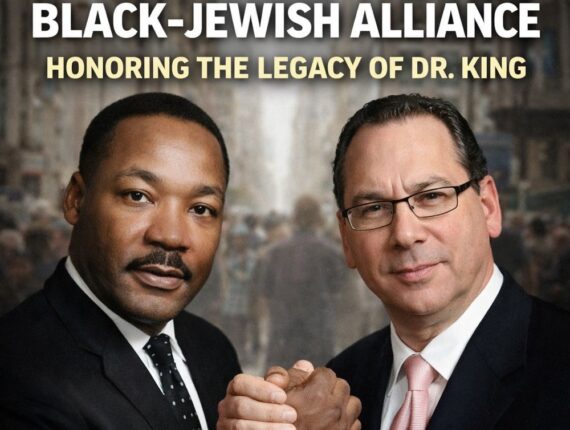
New York —As Black History Month highlights the historic alliance between Black and Jewish communities in the United States, Rabbi Marc Schneier is urging a reassessment of what that relationship requires today, particularly in New York City, where cooperation and tension have coexisted for decades.
Schneier, founder and president of the Foundation for Ethnic Understanding, argues that the partnership envisioned by Dr. Martin Luther King Jr. was never meant to rest solely on shared history. Instead, he says, it was designed as an ongoing moral responsibility requiring sustained effort from both communities.
His new book, Shared Dreams: Martin Luther King Jr. and the Jewish Community, revisits King’s belief that Black–Jewish cooperation was essential to the broader civil rights project and must continue to evolve amid changing social realities.
“Dr. King understood that alliances are not permanent,” Schneier said in remarks accompanying the book’s release. “They require maintenance, honesty, and the willingness to confront differences directly.”
Historians widely note that Jewish leaders and organizations played a visible role during the American civil rights movement of the 1950s and 1960s. Jewish activists marched alongside King in Selma, supported civil rights legislation, and contributed legal and organizational resources to the movement.
According to Schneier, King viewed this partnership as more than a matter of political convenience. Drawing on King’s speeches and correspondence, the book argues that he saw Black–Jewish cooperation as a model for pluralistic democracy in the United States.
King frequently spoke against antisemitism and described attacks on Jews as attacks on democracy itself. In a 1968 address to the Rabbinical Assembly, King stated that “peace for Israel means security,” reflecting his belief that Jewish self-determination and civil rights struggles were interconnected.
Schneier writes that King expected both communities to remain engaged even when disagreements emerged, rather than retreating into separation.
Nowhere are the challenges of that vision more visible than in New York City, home to the largest Jewish population outside Israel and one of the largest Black populations in the United States.
Over the past several decades, relations between segments of the two communities have experienced moments of strain, including disagreements over policing, education policy, and Middle East politics. Analysts at institutions such as the Anti-Defamation League and the American Jewish Committee have noted that rising antisemitism and political polarization have complicated intercommunal trust.
Schneier’s work focuses on rebuilding relationships through practical cooperation rather than public declarations.
Through the Foundation for Ethnic Understanding, he has partnered with prominent civil rights leaders, including Rev. Al Sharpton, National Urban League president Marc Morial, and NAACP president Derrick Johnson. The organization has facilitated joint initiatives addressing economic opportunity, community dialogue, and faith-based cooperation.
“These relationships are built quietly,” Schneier said. “Not through headlines, but through consistent engagement.”
Scholars of interfaith relations increasingly emphasize that lasting alliances do not require uniform agreement. Instead, they rely on mechanisms to manage disagreement constructively.
Dr. Jonathan Sarna, professor of American Jewish history at Brandeis University, has noted in previous research that Black–Jewish cooperation historically survived periods of tension because leaders maintained communication channels even during conflict.
Schneier argues that rebuilding trust today requires acknowledging real differences, particularly around political issues, without allowing those differences to define the relationship entirely.
He warns that symbolic gestures alone, such as joint commemorations or public statements, cannot replace sustained interpersonal engagement.
“Solidarity is not performance,” Schneier said. “It is presence.”
The book highlights examples of what Schneier calls “quiet solidarity,” including clergy exchanges, shared social service projects, and educational initiatives conducted outside media attention.
These efforts, he argues, reflect King’s original vision of cooperation grounded in shared ethical commitments rather than temporary political alignment.
Observers say such initiatives may be increasingly important as younger generations grow more distant from the lived memory of the civil rights era.
According to the Pew Research Center, generational shifts in religious identity and political engagement are reshaping how minority communities form alliances, making intentional relationship-building more critical than historical legacy alone.
Eighty years after the Holocaust and more than half a century after King’s assassination, Schneier believes the future of Black–Jewish relations depends less on nostalgia and more on practical collaboration.
For Jewish communities concerned about rising antisemitism and for Black communities confronting ongoing social inequities, he argues that renewed partnership offers mutual benefit grounded in shared democratic values.
“The relationship cannot survive on memory alone,” Schneier writes. “It must be lived, renewed, and practiced every day.”
As Black History Month continues, Schneier’s message echoes a central theme of his work and of King’s legacy: alliances endure not because they once existed, but because communities choose to sustain them.
Copyright © 2026 Foundation For Ethnic Understanding. All rights reserved. | Privacy Policy