


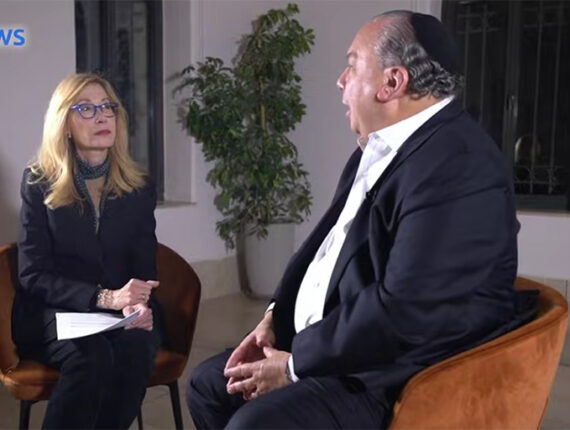
Rabbi Marc Schneier argued that contemporary Jewish communities—particularly in the United States—possess a level of strength, visibility, and influence unparalleled in modern history, even as hostility toward Jews intensifies globally.
By: Reuven Y. Epstein
At a time when headlines around the world chronicle a troubling resurgence of antisemitic incidents, a prominent American rabbi is offering a counternarrative that is both sobering and unexpectedly hopeful. As reported by VIN News on Monday, Rabbi Marc Schneier, a veteran leader in the interfaith movement and the presiding rabbi of the Hamptons Synagogue, argued that contemporary Jewish communities—particularly in the United States—possess a level of strength, visibility, and influence unparalleled in modern history, even as hostility toward Jews intensifies globally.
In a wide-ranging interview cited repeatedly by VIN News, Rabbi Schneier acknowledged that antisemitism is on the rise across Europe, North America, and Australia. Jewish organizations have documented a sharp increase in hate crimes, vandalism, online harassment, and intimidation, trends that many analysts attribute to the volatility of Middle Eastern politics and the amplification of extremist rhetoric through social media. Yet Schneier insists that focusing solely on the danger obscures a critical reality: Jewish life today is characterized not by fragility but by empowerment.
“Jews today are not isolated or voiceless,” Rabbi Schneier said. “We have political influence, communal infrastructure, and deep alliances that previous generations could scarcely imagine.”
According to the information provided in the VIN News report, Rabbi Schneier’s assessment rests on a historical comparison that is as stark as it is instructive. For much of the diaspora experience, Jewish communities existed at the margins of political and cultural life, often dependent on the goodwill of ruling authorities. Today, he says, the situation is fundamentally different.
In the United States, Jewish voters are politically engaged, Jewish advocacy organizations wield significant clout in Washington, and Jewish voices are deeply embedded in media, academia, philanthropy, and civic life. This infrastructure, Schneier argues, enables rapid, coordinated responses when antisemitism flares—whether through legal action, public campaigns, or coalition-building with other minority communities.
VIN News reported that Rabbi Schneier places particular emphasis on education as the bedrock of this empowerment. Jewish schools, adult learning programs, and public cultural initiatives have created a population that is not only historically literate but rhetorically equipped to challenge prejudice in the public square.
Another pillar of Rabbi Schneier’s analysis, as highlighted in the VIN News report, is the centrality of Israel to modern Jewish identity. While the Jewish state is often a flashpoint for controversy, Rabbi Schneier contends that it has paradoxically fortified diaspora communities by providing a focal point for solidarity and pride.
“Israel’s existence changes the psychology of Jewish life,” he explained. “It reminds Jews everywhere that they are part of a sovereign people with agency and destiny.”
This sense of collective agency, he believes, has transformed how Jews respond to hostility. Instead of retreating into insularity, communities now engage outwardly—mobilizing politically, forging alliances with Christian, Muslim, and secular leaders, and insisting on their place in national narratives.
VIN News has chronicled the scope of the antisemitic surge: synagogues defaced in Europe, Jewish schools threatened in Australia, and university campuses in North America roiled by rhetoric that too often blurs criticism of Israel with hostility toward Jews. Rabbi Schneier does not minimize the danger. But he cautions against despair, reminding audiences that Jewish history is punctuated by periods in which adversity catalyzed renewal.
“Every challenge has forced us to redefine ourselves,” he said in the interview. “This is no different.”
He pointed to the interfaith networks he has helped cultivate over decades as evidence that Jews are no longer alone in confronting hatred. Christian, Muslim, and secular allies, he said, now stand with Jewish communities in ways that were unthinkable a century ago.
While Rabbi Schneier’s tone is resolute, it is not complacent. The VIN News report noted that he called for sustained investment in education, civic engagement, and public advocacy as essential defenses against antisemitism. He urged Jewish institutions to continue cultivating leadership that is comfortable operating in the corridors of power and the arenas of cultural influence.
For Rabbi Schneier, the ultimate measure of communal health is not the absence of hostility but the capacity to meet it without fear. In that regard, he believes today’s Jews are uniquely prepared.
“We are living in a paradoxical moment,” he reflected. “Antisemitism is real and growing. But so too is Jewish confidence, Jewish presence, and Jewish power. That is the story we must tell alongside the headlines of hate.”
Copyright © 2026 Foundation For Ethnic Understanding. All rights reserved. | Privacy Policy